

London’s property market is difficult at the moment. Prices are under pressure, buyers are taking longer to make decisions, and properties that might once have attracted immediate interest are now competing for attention.
However, the market has not stopped.
People are still buying, selling and moving. What has changed is that they have become more selective. Buyers have more choice, vendors are more cautious, and estate agents can no longer rely on strong market conditions to compensate for average pricing, presentation or marketing.
For London estate agencies, this creates an obvious challenge. It also creates an opportunity.
When the market is rising, most agents appear busy. When conditions become difficult, the gap between agencies with a clear marketing strategy and those relying on portals, referrals and occasional social posts becomes much easier to see.
Is the London property market actually down?
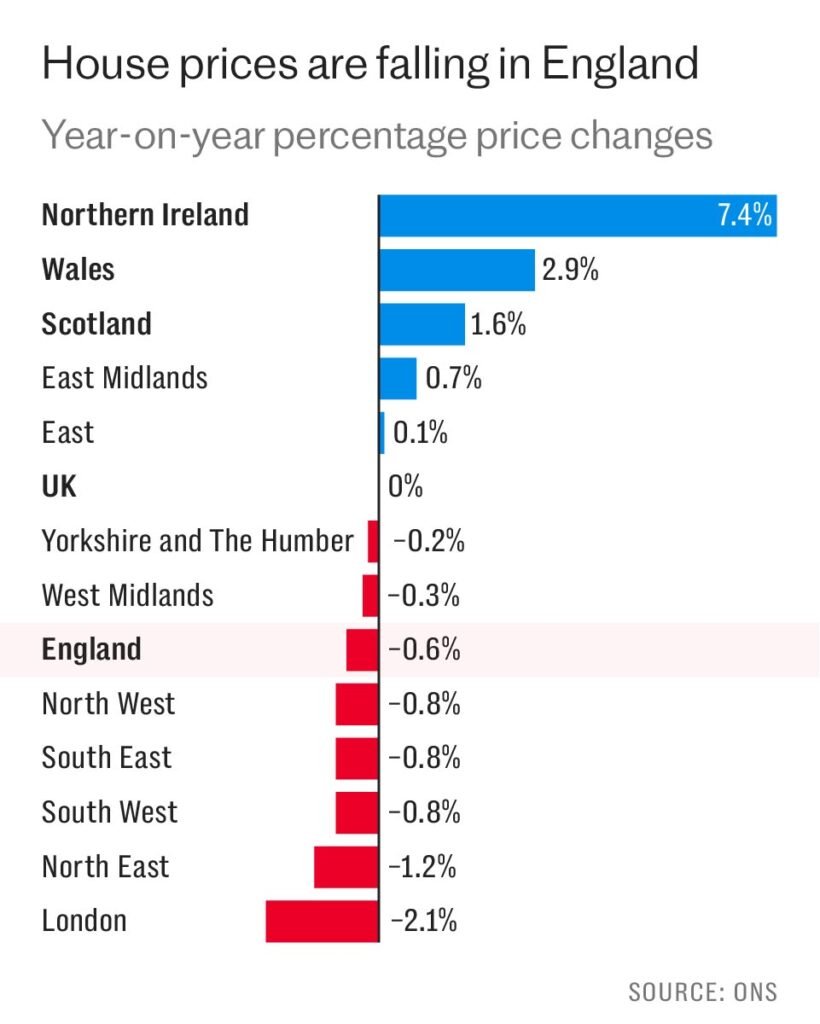
The latest evidence shows that London is performing significantly worse than most of the UK.
According to the Office for National Statistics, London house prices fell by 2.1% in the year to April 2026. This was the ninth consecutive month in which the capital recorded an annual fall.
Over the same period, average UK house prices increased by 3.8%, although the ONS noted that this national increase was heavily affected by comparisons with the sharp fall that followed the April 2025 Stamp Duty changes.
The headline figure also hides substantial differences between individual boroughs, property types and price bands.
Kensington and Chelsea, for example, recorded an annual fall of 8.4% in April 2026. Flats in the borough fell by 9%.
Brent recorded a 2.1% annual decline, broadly matching the London average, while Greenwich fell by 1.8%.
The important point is that there is no single London market.
A realistically priced one-bedroom flat in an area popular with first-time buyers may perform very differently from a large prime property, a flat with a short lease, or an apartment with high service charges.
Agents need to understand what is happening at a local and property-specific level, rather than relying on broad national headlines.
Buyer demand has weakened
Price movements are only one part of the picture.
The June 2026 RICS Residential Market Survey recorded a net balance of -29% for new buyer enquiries. This means considerably more surveyors reported falling demand than rising demand.
Newly agreed sales also remained negative, with a net balance of -32%. The figures had improved slightly compared with previous months, suggesting that the rate of deterioration may be slowing, but RICS still described the sales market as challenging.
Mortgage data tells a similar story.
The Bank of England reported that mortgage approvals for house purchases fell from 66,000 in April to 56,200 in May 2026. That was below the previous six-month average and the lowest monthly figure since December 2023.
Rightmove also reported that the average price of newly listed properties fell by 0.6% nationally in June. It was the largest June fall in 14 years.
The number of homes available remained historically high for the time of year, while buyer demand in May was 10% lower than a year earlier. Sales agreed were down 6% year on year, although they remained broadly in line with 2024 and above 2023 levels.
This is not a market with no activity. It is a market in which buyers have more leverage and are taking a more considered approach.
Why is London’s property market weak?
There is no single explanation. Several factors are interacting.
Mortgage affordability remains difficult
London buyers generally need larger deposits and mortgages than buyers elsewhere in the country.
This means that even relatively small movements in mortgage rates can materially affect affordability.
Rightmove’s June report placed the average two-year fixed mortgage rate at 5.07%, down slightly from 5.18% the previous month. That represents some improvement, but borrowing remains significantly more expensive than it was during the period of exceptionally low interest rates.
The Bank of England also reported that the effective interest rate on newly drawn mortgages increased from 4.08% in April to 4.22% in May.
For London buyers already stretching their budgets, higher repayments can reduce what they are willing or able to offer.
Buyers have more choice
When more properties are competing for fewer active buyers, the balance of power changes.
Buyers can compare listings more carefully. They can reject properties that appear overpriced, poorly presented or difficult to understand. They are also more likely to negotiate.
Rightmove found that the number of homes for sale remained at historically high levels for the time of year. Its assessment was that buyers were deliberating for longer and were looking for properties that stood out on either price or presentation.
In this environment, simply putting a property on the portals is not a complete marketing strategy.
Stamp Duty has a greater impact in London
Higher property values mean that Stamp Duty can represent a substantial additional cost for London buyers.
This is particularly relevant for existing homeowners who are considering whether to move but do not urgently need to do so. A large upfront tax bill can make remaining in the current property feel more attractive.
The effect is not necessarily that buyers disappear entirely. It can mean they delay, become more price-sensitive or expect a stronger reason to move.
London has a large flat market
Flats form an important part of London’s housing stock, but some come with additional concerns that buyers now examine more carefully.
These can include:
- Increasing service charges
- Lease length
- Building safety and cladding
- Major works
- Ground rent provisions
- Restrictions on alterations or letting
- The financial position of the freeholder or management company
A well-presented apartment can still sell, but agents must do more to address uncertainty.
Missing information is more likely to create hesitation in a cautious market.

Confidence is fragile
Political uncertainty, inflation, the cost of living and wider international events can all affect consumer confidence.
The June RICS survey found that respondents remained concerned about inflation, domestic political uncertainty and global conflicts. Its near-term outlook had improved, but the recovery remained fragile.
People rarely make a major property decision based on one economic headline. However, a steady stream of uncertainty can make them less willing to commit.
Sellers and buyers do not always agree on value
One of the biggest problems in a slower market is often the gap between seller expectations and buyer behaviour.
A vendor may base their expectations on a neighbour’s sale from two years ago, an online valuation, or the highest figure given by an agent during an appraisal.
Buyers are basing their decisions on current mortgage costs, competing stock and what they believe they can negotiate.
When these expectations do not meet, properties sit on the market.
Rightmove specifically warned that overpricing at launch can make it difficult for sellers to regain momentum after a later reduction.
What does this mean for estate agents?
The easy reaction to a weaker market is to become defensive.
Marketing budgets are reduced. Content becomes less frequent. The agency waits for conditions to improve.
I believe this is usually the wrong approach.
A slower market does not make marketing less important. It makes average marketing less effective.
There are fewer active opportunities, so agents must work harder to win their share of them. Every instruction matters more. Every buyer enquiry needs better qualification and follow-up. Every property needs to compete more effectively.
For small and midsized agencies, the priorities should be clear:
- Win more of the available instructions.
- Demonstrate why vendors should trust you.
- Reach buyers beyond the portals.
- Stay visible before homeowners are ready to sell.
- Build marketing systems that produce demand consistently.
1. Use social media to demonstrate expertise, not just activity
Many estate agents still treat social media as a noticeboard.
They publish new listings, sold graphics, staff birthdays and occasional national property statistics. That may show that the business exists, but it does not necessarily give a homeowner a reason to instruct the agency.
In a slower market, the strongest social content answers the questions sellers are already asking:
- Is now a bad time to sell?
- Why has my property not sold?
- Should I reduce the asking price?
- What are buyers looking for in my area?
- How long are properties taking to sell?
- Which property types are still attracting demand?
- What can an agent do beyond listing on Rightmove?
Agents should use their social channels to interpret the market, not just report it.
A national statistic becomes more useful when an agent explains what it means for a two-bedroom flat in Wandsworth, a family house in Enfield or a period conversion in Islington.
The agency’s people should also be visible.
Presenter-led videos, market updates, property tours and practical advice allow potential clients to become familiar with the agents before booking a valuation.
For our clients, we focus less on follower numbers in isolation and more on views, engagement, profile activity, inbound enquiries and the number of relevant local people repeatedly seeing the brand.
Druce is a useful example. Through consistent, high-volume content and ongoing testing, its Instagram generated hundreds of thousands of views and created a much larger audience regularly exposed to the brand.
Follower growth was a result, but reach and attention were the more important commercial assets.
2. Use Google Ads to capture existing intent
A homeowner typing “estate agent valuation in Fulham” or “best estate agent in Greenwich” is displaying more immediate intent than someone passively scrolling through Instagram.
Small and midsized agencies should build tightly structured campaigns around the areas and services they genuinely want to win.
Relevant searches might include:
- Estate agents in a specific area
- Property valuation searches
- Sell my house or flat
- Best local estate agent
- New-build homes
- Flats or houses for sale by postcode
- Specific property developments
- First-time buyer property searches
Agents don’t have to rely entirely on portal demand. They can actively build additional routes to buyers and Google Ads are a great way to capture those high intent buyers.
3. Invest in SEO before you urgently need leads
SEO is often misunderstood because it doesn’t produce results as quickly as paid advertising.
That does not make it less valuable.
A well-structured estate agency website can capture homeowners and buyers who are researching long before they contact an agent.
Useful search-focused content might include:
- Local property market reports
- Area guides
- Selling guides
- Advice for landlords considering selling
- Guides to service charges and leasehold sales
- Content for first-time buyers
- Explanations of the valuation process
- Local Stamp Duty examples
- Property-type-specific advice
- Pages targeting individual neighbourhoods and postcodes
Agents should not create dozens of thin pages with the name of a different location inserted into the same template.
The content should demonstrate genuine local knowledge.
A strong local market page might explain:
- Typical property types
- Buyer demographics
- Transport connections
- Schools and amenities
- Current supply
- Recent sales
- The types of property attracting interest
- Common reasons transactions are delayed
- How the agency markets homes in that area
SEO is especially important during difficult periods because agents need to reduce their dependence on one source of leads.
The agencies that invest only when they urgently need instructions will usually find that organic visibility takes too long to build.
4. Reactivate the existing database
Many agencies focus heavily on attracting new leads while underusing the contacts they already have.
A slower market is a good time to review the CRM and identify:
- Previous valuation leads
- Withdrawn vendors
- Expired instructions
- Landlords who may consider selling
- Buyers who paused their search
- Applicants who need to update their requirements
- Past clients who may move again
- Buyers who enquired about similar properties
- People who previously could not secure a mortgage
These contacts should not all receive the same mass email.
Segmented communication is more likely to produce a response.
A landlord might receive information about current sale prices and buyer demand. A previous buyer could be invited to update their budget and preferred locations. A withdrawn vendor might be offered a review of why the property failed to sell.
Database marketing is often one of the least expensive ways to create conversations, but it depends on clean data, useful segmentation and consistent follow-up.
Should estate agents cut marketing when the market slows?
Marketing budgets should always be judged against commercial performance.
Agents should not continue funding channels that are poorly managed, badly tracked or producing no meaningful outcomes.
But reducing marketing simply because the market is difficult can create a larger problem.
When demand is weaker, agencies need more visibility, stronger differentiation and better lead generation, not less.
The emphasis may need to change.
An agency could move budget away from broad awareness activity and place more into:
- Vendor lead generation
- High-intent Google searches
- Retargeting
- Local market content
- Database reactivation
- Case studies
- Video
- Property-specific advertising
- SEO pages supporting priority locations
The question should not be, “Can we afford to market during a slow period?”
It should be, “Which marketing activity is most likely to help us win instructions, reach active buyers and build future demand?”
The agencies that respond now will be better positioned later
London’s property market will not remain in exactly the same condition forever.
Mortgage rates, confidence, supply and economic conditions will continue to change.
However, agencies don’t need to wait for the market to recover before improving their position.
A slower market reveals where the weaknesses are:
- Overreliance on portals
- Inconsistent content
- Weak local search visibility
- Poor database management
- Generic valuation campaigns
- Limited tracking
- No clear property launch strategy
- Too little differentiation from competitors
Addressing those weaknesses now helps an agency compete in the current market and creates a stronger platform when activity increases.
The London market hasn’t disappeared. It’s become more selective.
Properties can still sell. Vendors will still change agents. Buyers are still searching. But pricing, presentation, trust, follow-up and proactive marketing now matter much more.
For small and midsized estate agencies, that is the central challenge and the opportunity.