
Most estate agents know they should be using social media.
The problem is that many still treat it like a box to tick.
They post a new listing, share a “just sold” graphic, upload the occasional market update and hope that, eventually, more followers will turn into more business.
But real estate social media marketing does not work because you post more often.
It works when you give people a reason to trust you.
That distinction matters.
Because when someone decides to sell, let, buy or invest, they rarely choose an agency based on one post. They choose the agency they already recognise. The one they have seen offering useful advice. The one whose team feels approachable. The one that has quietly built trust long before the valuation request.
That is the real opportunity.
Social media is not just a place to advertise properties. It is a place to shape how people feel about your agency before they ever speak to you.
So if your feed currently looks like a property portal with a logo on it, this guide is for you.
Here are 10 principles every estate agent should follow to make social media more useful, more memorable and more commercially valuable.
1. Stop Selling. Start Building Trust.
The biggest mistake estate agents make on social media is assuming every post needs to sell something.
It does not.
In fact, if every post feels like a sales message, most people will ignore it.
That is because the majority of your audience is not ready to move today. They might sell in six months, eighteen months or three years. They may not need a valuation right now, but they are still forming opinions.
They are noticing which agents understand the market. They are seeing who communicates clearly. They are deciding who feels professional, friendly and trustworthy.
That is where social media becomes powerful.
Your goal is not to convince someone to instruct you from a single Instagram post. Your goal is to make sure that when they do need an agent, your business is already the one they remember. That means understanding your target audience and creating content that gives those people a reason to keep paying attention.
A useful question to ask before posting is:
Does this make someone trust our agency more than they did before?
If the answer is yes, it is probably worth posting.
Trust-building content can include:
- explaining what is happening in the local market
- answering common seller questions
- showing how your team works behind the scenes
- giving honest advice about preparing a home for sale
- sharing client stories with context
- helping buyers understand the process
This is the kind of content that makes people feel like they know you before they meet you.
2. Your Feed Shouldn’t Look Like Rightmove
Rightmove is where people go when they are actively searching for property.
Instagram, Facebook and TikTok are different.
People do not usually open social media hoping to see another three-bedroom terrace with a floorplan and a caption that says “early viewing recommended”.
That does not mean you should never post listings. Of course you should. Properties are a core part of what you do.
But if your feed is mostly:
- Just Listed
- Just Sold
- Price Reduced
- Open House
- Just Listed
- Just Sold
then you are giving people very little reason to follow you.
A property portal is useful because it shows available homes.
A social media account is useful because it builds a relationship with your audience.
Those are not the same thing.
The strongest estate agency accounts create engaging content that is valuable even when someone is not actively moving. That could be a local area guide, a behind-the-scenes video, an explanation of how valuations work, a quick tip for sellers, or a member of the team talking honestly about the market.
This matters because most future sellers are not yet future sellers in their own minds. They are homeowners, landlords, buyers, parents, investors and locals. If your content only speaks to people who are ready to transact today, you miss the much larger audience who may need you later.
A better content mix might look like this:
- one property tour
- one local market insight
- one team video
- one seller tip
- one local area feature
- one client success story
That immediately creates a more interesting, more human and more followable brand.
The principle is simple:
Listings show what you sell. Content shows why people should trust you.
That is why “just sold” posts often underperform. They may make the agency feel successful internally, but they rarely offer much value to the audience.
A better version would tell the story behind the sale.
For example:
Why did the seller choose you?
What was the strategy?
How quickly did interest come in?
What advice helped the property perform better?
What can other homeowners learn from it?
That turns a self-congratulatory post into something useful.
And useful content is far more likely to be saved, shared and remembered.
3. Become the Local Expert
Estate agents often say they are local experts.
Social media is where you prove it.
The mistake is thinking local expertise only means knowing property prices. That is part of it, but it is not the whole story.
A truly local agency understands the streets, schools, cafés, transport links, parks, developments, buyer behaviour and community conversations that shape an area.
That knowledge is incredibly valuable content.
For example, an estate agent could post about:
- the best roads for families in the area
- what buyers should know before moving locally
- new restaurants or businesses opening nearby
- school catchment considerations
- transport changes affecting demand
- the difference between two neighbouring villages or postcodes
- what £500,000 buys in the area today
- why some homes sell faster than others locally
This type of content works because it is relevant to more than just active buyers and sellers.
Someone might not be planning to move right now, but they may still care about their local area. They may share a post about a new café, save a market update or send a local property insight to a friend.
That is how your agency becomes part of the local conversation and why local knowledge should sit at the heart of your content strategies.
It also helps separate independent estate agents from larger competitors.
A national agency may have more budget, but a good independent agency should have more personality, more local knowledge and a stronger connection to the community.
That is a real advantage, but only if you show it.
The aim is not to say “we are local experts” in every caption.
The aim is to publish content that makes the conclusion obvious.
When someone sees your videos and thinks, “They really understand this area,” you are doing it right.
Key takeaway: social media should not just show that you sell homes in an area. It should show that you understand the area better than anyone else.
4. Make Video Your Biggest Opportunity
I wrote an article recently about how video outperforms images in real estate marketing.
Not because every agency needs to dance on TikTok or chase every trend, but because video is the fastest way to build familiarity.
A photo can show a property.
A video can show the property, the person presenting it, the atmosphere, the story and the expertise behind it.
That matters because estate agency is still a people business. Sellers want to know who they are trusting with their home. Buyers want to feel confident they are speaking to people who understand what they need. Landlords want to know their investment is in safe hands.
Video helps people feel that before they ever enquire.
It can be used for:
- property tours
- valuation advice
- market updates
- team introductions
- local area guides
- behind-the-scenes moments
- buyer and seller education
- client stories
The key is not just to film properties. It is to use video to make your agency feel more visible, more human and more trustworthy.
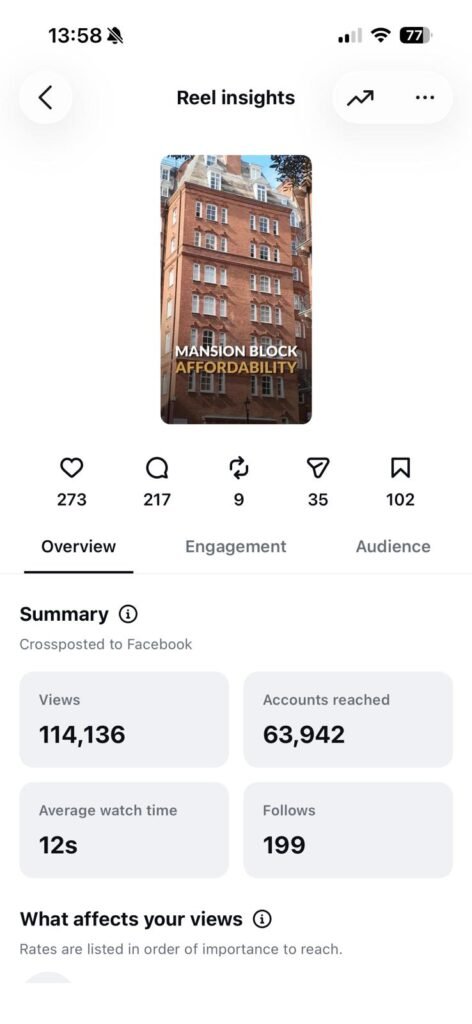
This is what we’ve been focused on for our client Druce. The video first strategy has led to 759,000 views and 250,000 accounts reached in the last 30 days.
The important point is not simply that the videos reached a large audience.
It is that the right strategy allowed a professional estate agency brand to generate organic reach at a scale many businesses assume is only possible for creators or entertainment accounts.
Video needs to be treated as part of the strategy, not something squeezed in when someone remembers to film.
5. Show the People Behind the Brand
People do not trust logos.
They trust people.
This is one reason independent estate agents have such a strong opportunity on social media. Smaller agencies often have more personality, more local knowledge and more direct relationships with clients than larger competitors.
But many hide that advantage.
Their social media is polished, branded and professional, but it does not feel human.
That is a missed opportunity.
Your audience should know who works in your agency. They should recognise your valuers, negotiators, founders, lettings team and marketing team. They should understand what you care about, how you work and what makes you different. For estate agents, social media can effectively become an extension of the relationship-building and professional networking that already happens offline.
That does not mean every post needs to be personal. It simply means your content should not feel faceless.
You can show your team through:
- short advice videos
- behind-the-scenes clips
- “day in the life” content
- team introductions
- office moments
- staff recommendations for local places
- valuation walk-throughs
- honest market commentary
This kind of content builds familiarity.
And familiarity matters.
If a homeowner has watched your team give helpful advice for months, your agency feels less like a stranger when they eventually need a valuation.
That is the quiet power of social media.
It allows people to feel like they know you before they have met you.
This is especially important for independent agencies with small teams. You do not need to look like a corporate brand. In many cases, that is the last thing you should want.
Your size can be a strength.
Use social media to show the care, personality and expertise that clients get when they work with you.
Key takeaway: the more human your agency feels online, the easier it is for people to trust you offline.
6. Build a Brand, Not Just an Audience
Follower growth is useful, but it is not the goal.
The goal is to build a brand people remember.
There is a difference.
An audience is a group of people who have clicked follow.
A brand is what those people think and feel when they see your name.
Do they see you as premium? Friendly? Local? Innovative? Knowledgeable? Approachable? Specialist? Trustworthy?
If your content does not consistently reinforce a clear impression, your brand becomes forgettable.
This is where many estate agents go wrong.
They post whatever is available that week. A listing. A sold graphic. A staff birthday. A mortgage update. A random trend. A repost from a portal. There is no thread tying it all together.
Over time, that creates noise rather than recognition.
Strong real estate social media marketing should make your agency easier to understand and reinforce a consistent impression of the business.
For example:
- A luxury agency should feel considered, polished and aspirational.
- A local family-run agency should feel warm, familiar and community-led.
- A new-build specialist should feel knowledgeable, visual and commercially sharp.
- A lettings agency should feel practical, responsive and trusted by landlords.
There is no single correct brand.
But there should be a clear one.
Before posting, ask:
What do we want people to remember about us?
Then create content that reinforces that idea repeatedly.
Recognition creates familiarity. Familiarity creates trust. Trust wins instructions.
That is why social media should never be treated as random posting. It is one of the most visible expressions of your brand.
7. Use Organic First, Then Paid
Organic social media and paid advertising do different jobs.
Organic social media builds trust with people who already follow you or discover you naturally.
Paid social media gets your agency in front of people who may not know you yet.
Both are valuable, but they work best when they support each other.
The mistake many estate agents make is running paid adverts before their organic presence is ready.
Someone might see your advert, click through to your Instagram profile or visit your website, then immediately make a judgement about your business.
- Do you look active?
- Do you look professional?
- Do you look trustworthy?
- Do you understand your local market?
- Do you have useful content, strong visuals and a clear brand?
If the answer is no, paid advertising may still generate clicks, but it will be much harder to convert that attention into trust.
That is why organic first matters.
Organic social media gives your agency the foundations paid advertising needs to perform properly. It helps your brand look credible when someone checks you out. It gives potential clients more reasons to trust you. It shows that your agency is active, knowledgeable and engaged.
Paid advertising can then accelerate that trust-building process by introducing your agency to more of the right people.
Our client Haus is a strong example of this.
For Haus, the objective was generating qualified buyer leads.
Using Meta advertising, our campaigns have generated hundreds of qualified buyer leads per month, leading to multiple property sales.
But before we just “ran ads”, we needed to ensure the organic ‘foundations’ were in place.
The ad might be the first thing someone sees, but it is rarely the only thing they judge. They may look at your page, your content, your website, your reviews and the way your agency presents itself online.
That whole journey matters.
Paid advertising is not a shortcut around building trust.
It helps more people discover a brand that already looks worth trusting.
So before running ads, ask:
If someone clicked through to our page today, would they trust us?
If the answer is yes, paid social can become a powerful growth channel.
If the answer is no, strengthen the organic foundations first.
8. Test Everything
No estate agency knows exactly what will work before they post.
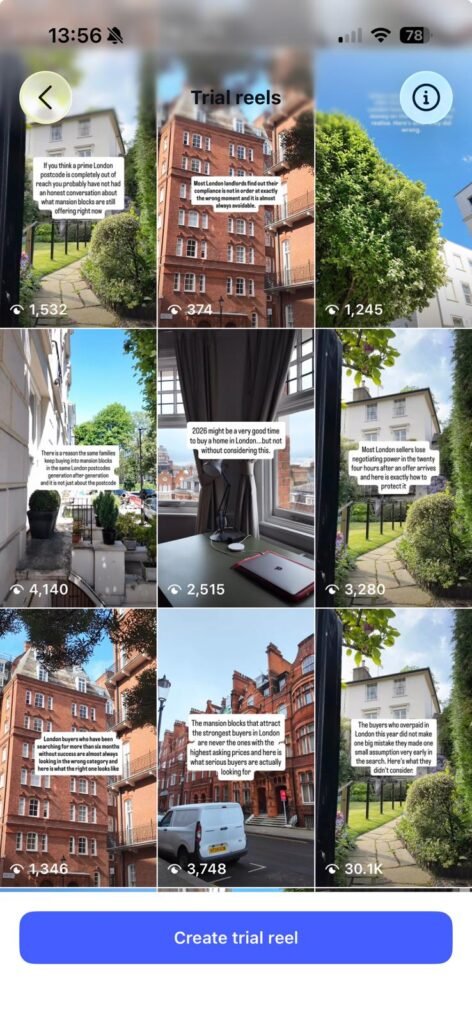
That is why testing matters.
The agencies that grow fastest on social media are not always the most creative. They are usually the ones willing to learn the quickest.
They test different:
- video hooks
- captions
- presenters
- topics
- thumbnails
- posting times
- formats
- calls to action
- advert creative
Then they pay attention to what the audience is telling them.
This is where many agencies fall short. They post for a few months, see limited growth and conclude that social media does not work.
But social media is not a one-off campaign. It is a feedback loop.
Every post gives you information.
If a video gets strong saves, people found it useful.
If a post gets shared, it resonated enough for someone to send it to another person.
If a Reel gets strong reach but no enquiries, it may have attracted attention without attracting the right audience.
If a paid advert gets leads but poor quality enquiries, the targeting or messaging may need adjusting.
The goal is not to find one perfect formula and repeat it forever.
The goal is to keep improving.
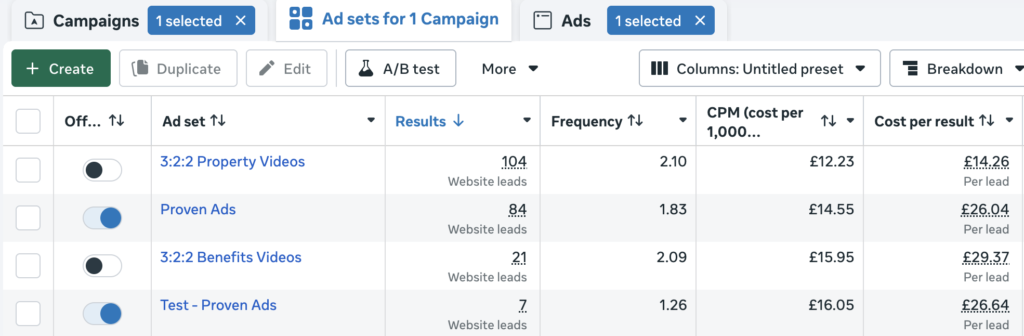
This is exactly why our campaigns are reviewed so frequently. The ad creative is not left untouched for months. It is adjusted almost every week because small improvements in creative can have a major impact on performance over time.
The same principle applies to organic social.
Your first month of content will rarely be your best.
Your sixth month should be better.
Your twelfth month should be better again.
That only happens if you treat social media as something to improve, not something to simply maintain.
9. Measure What Actually Matters
A lot of estate agents measure the wrong things.
Follower count is the obvious one, and I wrote about it’s importance here.
Of course, followers can be useful. A growing audience usually means more people are paying attention to your brand.
But followers alone do not pay the bills.
An agency with 2,000 engaged local followers can be in a far stronger position than one with 20,000 followers who never interact, never enquire and never instruct.
The only metric that truly matters is whether your marketing helps the business grow.
That might mean:
- more valuation requests
- more buyer enquiries
- stronger brand recognition
- better quality leads
- more website visits
- more instructions
- more revenue
From a social media perspective, saves and shares are particularly useful signals.
A save usually means someone found the content valuable enough to return to later.
A share means someone found it relevant enough to send to another person.
Both are stronger indicators of trust and relevance than a passive like.
That does not mean you should ignore reach or views. They matter, especially when you are trying to increase awareness. But reach without trust rarely turns into business.
The question is not simply:
How many people saw this?
The better question is:
Did this make the right people more likely to trust us?
That is a much better way to judge whether your social media is moving the business forward.
10. Play the Long Game
Social media works best when you stop expecting instant results.
One post will not transform your agency.
One viral video will not build a trusted brand.
One month of content will not undo years of inconsistent marketing.
But showing up consistently over time can change how people think about your business.
This is especially true in property because people do not need an estate agent every week. A homeowner may follow your account for a year before deciding to sell. A landlord may watch your content quietly before asking for advice. A buyer may see your videos repeatedly before registering interest.
You may not see all of that happening in real time.
But it matters.
Every useful post builds familiarity.
Every helpful video strengthens your authority.
Every behind-the-scenes clip makes your team feel more approachable.
Every strong piece of creative makes your brand easier to remember.
That is why thinking of marketing as an expense is dangerous.
Good marketing is an asset.
It compounds.
The agencies that benefit most from social media are usually not the ones that try it for three months and stop. They are the ones that commit to building a brand people know, like and trust over the long term.
Because selling is about trust.
And trust is built before the instruction, not after it.
Final Thoughts
Real estate social media marketing is not about posting more listings, chasing trends or copying what every other agency is doing.
It is about building trust at scale.
That means showing your expertise, making your team visible, educating your audience, becoming part of the local conversation and creating content that people actually want to consume. The best content strategies bring all of those elements together rather than treating each post in isolation.
For independent estate agents, this is a huge opportunity.
You do not need the biggest budget in your market.
You do not need to behave like a national brand.
You need a clear strategy, a recognisable voice and the discipline to keep improving.
The agencies that win on social media over the next few years will not be the ones shouting the loudest.
They will be the ones people trust the most.
And that starts long before someone books a valuation.
Need Help Improving Your Estate Agency’s Social Media?
At Crimson Social, we specialise in marketing for estate agents, letting agents, developers and real estate brands.
We help property businesses build trust, grow their online presence and turn attention into long-term commercial growth through organic social media, paid advertising, content creation and SEO.
If you want your agency to become more visible, more trusted and more memorable online, we can help you build the strategy to get there.
Book a discovery call with Crimson Social.