

Wondering why Meta keeps flagging or restricting your property ads, or why they are simply not generating the enquiries you expected?
For estate agents, advertising on Facebook and Instagram can sometimes feel more complicated than it should.
You create the campaign and choose an audience. Then Meta’s housing rules remove some of the targeting options you expected to use.
That can make it seem as though Meta no longer wants estate agents advertising property.
That is not the case.
Meta ads for estate agents are still available, but housing advertising comes with additional rules. Those rules affect how you can target audiences and how you should build your campaigns.
As a result, relying on narrow audience targeting to carry an average advert is much less effective.
Strong creative, a clear campaign goal and a simple route from ad to enquiry now matter more.
So, if your Facebook property ads are not performing as expected, these are some of the first areas we would review.
Can Estate Agents Still Run Meta Ads?
Estate agents can still advertise properties on Facebook and Instagram.
Much of the confusion comes from Meta’s rules for housing advertising.
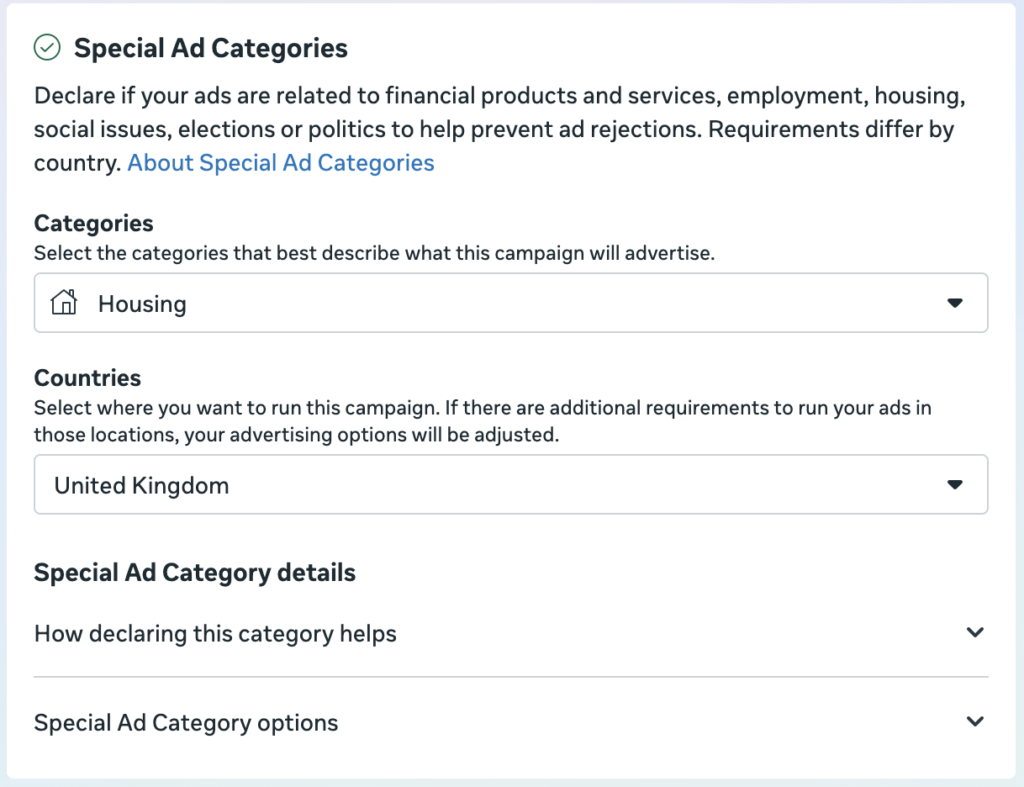
Meta treats housing and real estate advertising as a specific category. Advertisers running these campaigns must follow additional requirements.
For an estate agent, one of the most noticeable differences is the audience targeting available.
In a standard campaign, you might expect to build a detailed audience using a long list of characteristics or interests. Housing advertising can limit some of those options.
As a result, real estate Facebook ads can feel harder to control.
However, broader targeting does not automatically lead to poorer results.
It means your creative, offer and campaign structure need to play a bigger role.
Your creative has to do more of the targeting
When Meta gives you fewer ways to narrow an audience manually, the advert itself becomes one of your most important targeting tools.
Consider two property adverts.
The first is a generic video tour of a new-build apartment with the caption:
“Discover your dream home.”
The second opens with:
“Two-bedroom apartments in Battersea from £425,000.”
The second gives the viewer three useful pieces of information immediately: the property type, location and starting price.
A buyer looking for an apartment around that price in Battersea has a reason to continue watching. Someone looking for a completely different type of property does not.
Your creative has already helped qualify the audience.
A strong real estate ad should quickly communicate:
- what the property is
- where it is
- the price
- its strongest selling point
- who it is likely to appeal to
- what the viewer should do next
Producing high quality photography and video still matters, but production quality alone will not make an advert effective.
The message matters just as much.
Choose the right format for the property
Different properties suit different advertising formats.
Video ads can work particularly well when a property has a feature, story or lifestyle element worth showing.
That could be an impressive view, unusual architecture, a roof terrace or access to exceptional amenities.
Video can communicate these features more effectively than a single static image.
A video tour can also work well when it has a clear direction. Rather than moving through every room in order, build the video around the strongest reason someone might want the property.
Carousel ads offer another option.
They allow potential buyers to move through several images, property types or amenities within the same advert. This can work well for developments with several units or a range of facilities.
A virtual tour can then give interested buyers a more detailed look at the property later in the journey.
Choose the format that communicates the offer most clearly.
Stop asking one campaign to do everything
Another common problem is giving one campaign too many jobs.
An estate agent might expect one campaign to:
- generate buyer enquiries
- attract vendors
- increase followers
- build local brand awareness
- promote several listings
- drive website traffic
Those are different objectives.
Your campaign goal should determine how you build the campaign.
A property campaign might focus on generating enquiries for one development.
A seller lead generation campaign might focus on generating valuation opportunities.
A brand awareness campaign might distribute your strongest social media content to more relevant people in your area.
Each goal needs its own message, creative and method of measuring success.
Trying to achieve everything through one campaign usually makes it harder to understand what is working.
We cover this in more detail in our guide to Meta Ads for Estate Agents.
Better targeting starts with a stronger offer
Broader targeting makes the offer inside your advert even more important.
The strongest feature of the property should usually lead the campaign.
That might be:
- an attractive price
- a desirable location
- an unusual feature
- a large garden
- an impressive view
- a purchase incentive
- proximity to a station
- access to a gym, pool or other amenities
Compare these two messages:
“Stunning two-bedroom apartment now available.”
and:
“Two-bedroom apartments in Zone 2 from £450,000, five minutes from the station.”
The second gives a potential buyer specific reasons to pay attention.
Meta also provides marketing tools that can support your campaigns. These may include custom audiences where their use is eligible and permitted.
Those tools can help, but they cannot compensate for an advert that lacks a clear reason to click.
Your landing page could be costing you enquiries
Sometimes the advert generates interest, but the next stage loses the potential buyer.
A person arriving from Facebook or Instagram should immediately recognise the property and offer they saw in the advert.
A good landing page should make the following information easy to find:
- property or development name
- location
- pricing
- key selling points
- photography or video
- availability
- next steps
The call to action should also be clear.
A campaign focused on viewing requests should make booking a viewing straightforward.
A development campaign focused on registrations should make the enquiry form easy to find and complete.
Every extra step creates another opportunity for a potential buyer to leave.

Lead forms or a landing page?
Both approaches have a place in property advertising.
Meta lead forms allow someone to submit their details without leaving Facebook or Instagram.
This can reduce friction and work well for simple actions, such as registering interest or requesting further information.
A landing page gives you more space to explain the property before asking for an enquiry.
This can suit properties where buyers need more information before taking the next step. Photography, floorplans, specifications, amenities and pricing can all help someone decide whether the property is relevant.
Neither option is automatically better.
Test both approaches and compare the quality of the enquiries they generate, not just the number of form submissions.
Increasing your daily budget will not fix a weak campaign
Putting more money behind a campaign does not automatically improve the results.
A larger daily budget simply gives Meta more money to distribute.
Before increasing spend, review the fundamentals:
- Give the campaign one clear objective.
- Make the offer easy to understand.
- Use creative with a strong property hook.
- Check that conversion tracking works correctly.
- Make sure the landing page matches the advert.
- Keep forms short and easy to complete.
- Review the quality of the leads being generated.
If these elements need improvement, increasing the budget may simply increase the amount you spend on the same problems.
Improve the campaign first, then decide whether additional budget makes sense.
What should you do if Meta rejects your property ad?
A rejected advert does not mean Meta has banned your estate agency from advertising.
Meta can reject or restrict adverts for several reasons.
Start by checking the reason shown in Ads Manager. Then compare the advert and campaign setup with Meta’s current advertising policies.
You should also make sure you have identified the campaign as housing-related when Meta requires this.
Avoid trying to work around Meta’s housing rules simply to regain additional targeting options.
A better approach is to build a campaign that follows the rules and performs within them.
Do Facebook ads work for estate agents?
Yes, but targeting settings alone will not determine whether Facebook ads work.
Estate agents can use Meta ads for:
- buyer enquiries
- development registrations
- seller lead generation
- valuation campaigns
- local brand awareness
- property launches
Successful campaigns usually combine a strong offer, relevant creative, a clear structure and a simple route to enquiry.
That is where the biggest shift has happened.
Estate agents once spent a lot of time thinking about which targeting options to select inside Ads Manager.
Now, advertisers should give more attention to what potential clients actually see.
That means focusing on the property, the hook, the message, the offer and the experience after someone clicks.
Get those elements right and broader targeting becomes far less intimidating.
Need help with Meta ads for your estate agency?
Crimson Social manages paid advertising for estate agents, including campaigns for property enquiries, valuation opportunities and local brand awareness.
You can also read our guide to Meta Ads for Estate Agents for the campaign structure we recommend.